

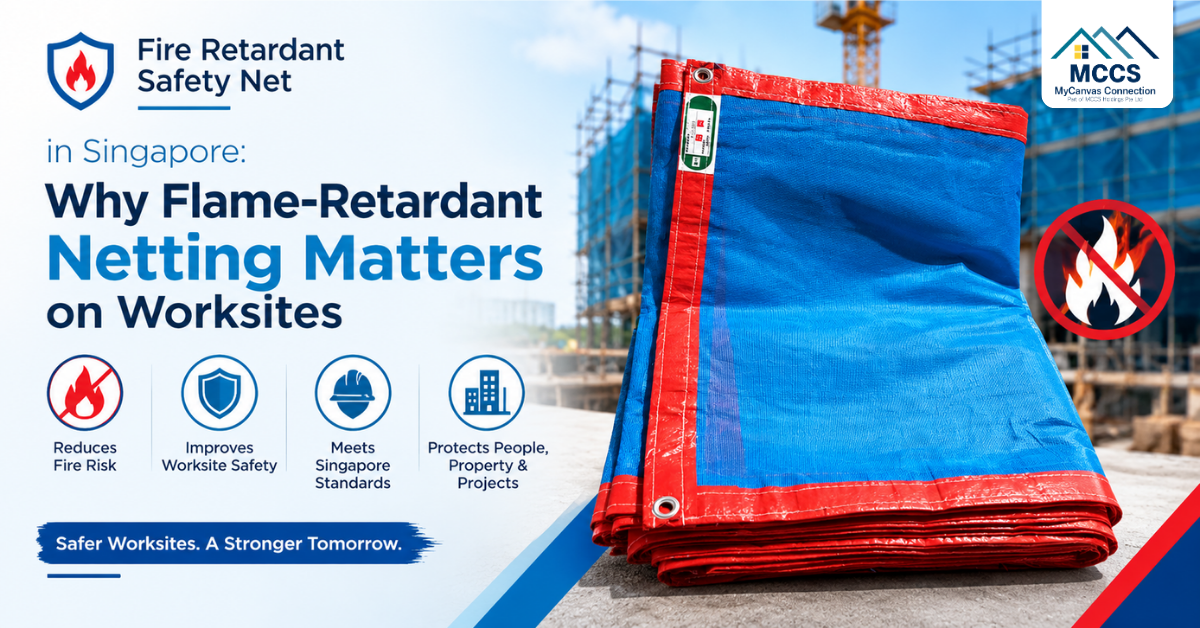
Fire Retardant Safety Net in Singapore: Why Flame-Retardant Netting Matters on Worksites
Most people assume the net on a scaffold is already safe in a fire. It is not always so. Standard netting is mainly designed to contain debris and dust, and it may not be flame-retardant. If your project involves welding, grinding, cutting or other hot work near the scaffold, or if the building type or contract calls for specific fire-safety measures, a fire retardant safety net is worth asking about from the start. This article explains the difference, when it matters and what to ask your supplier. It builds on our general scaffold netting guide.
What Is a Fire Retardant Safety Net?
A fire retardant safety net is a mesh netting made or treated to resist ignition and slow the spread of flame compared with untreated material. It is used in the same way as standard debris or scaffold netting, fixed to scaffolding and facades, but with an added fire-safety property.
Flame-retardant does not mean fireproof. Under sustained heat, any synthetic material can be damaged. The purpose is to reduce the risk and slow flame spread, not to make the net immune to fire.
Standard vs Flame-Retardant Netting
| Feature | Standard scaffold netting | Fire retardant safety net |
|---|---|---|
| Main purpose | Debris and dust containment | Debris and dust containment with added fire-safety property |
| Fire behaviour | May not be flame-retardant | Designed to resist ignition and slow flame spread |
| Typical use | General construction and repainting | Hot work, specific fire-safety requirements |
| Documentation | Basic specifications | Ask for grade and test or certification information |
See our standard Scaffold Netting and the Fire Retardant Safety Net for specialised requirements.
When Should You Consider Flame-Retardant Netting?
The need depends on the project, the building and applicable requirements. Common situations include:
- Hot work near the scaffold: welding, cutting, grinding or torch work that can throw sparks
- Contract or client specifications that call for flame-retardant materials
- Occupied or sensitive buildings where fire-safety expectations are higher
- Dense urban sites where a fire could affect neighbouring properties
- Long-duration projects where netting stays up for many months
If you are unsure, check with your main contractor, safety officer or the relevant authorities about what applies to your project. We do not set regulatory requirements; we help you source materials that match them.
What to Ask Your Supplier
- Is this net flame-retardant, and to what standard or test?
- Can you provide documentation or test information for the grade?
- What material and weight (GSM) is it?
- Is it UV-stabilised for Singapore’s weather?
- Is it suitable for the type of work I am doing (hot work, repainting, demolition)?
- What sizes, colours and edge finishes are available?
- Can it be reused across project phases?
Fire Safety Is More Than the Net
A flame-retardant net is only one layer. Good practice on site includes:
- Following hot work permits and procedures
- Keeping combustible materials away from sparks
- Having appropriate fire extinguishers within reach
- Inspecting netting for damage or build-up of dust and debris
- Training workers on site fire-safety measures
Netting should support, not replace, your site fire-safety plan.
Combining Netting With Other Site Protection
Flame-retardant netting often works alongside other measures. For general debris and dust, see our Dust Control Netting. For lift areas, consider our Fireman Lift Protector. For an overview of all options, browse our Construction Safety Netting range or read our construction safety netting guide.
Care and Reuse
- Inspect regularly for tears, burn marks and loose fixings
- Remove accumulated dust and debris, which can be a fuel source
- Clean according to the supplier’s guidance
- Store dry and away from heat sources
- Retire any section showing damage
Frequently Asked Questions
Is scaffold netting fire-retardant?
Standard scaffold netting is not always fire-retardant. Flame-retardant grades may be available depending on the project and application, so state your requirement when you enquire.
What is a fire retardant safety net?
It is a mesh net made or treated to resist ignition and slow flame spread, used around scaffolding and facades in the same way as standard netting.
Is flame-retardant the same as fireproof?
No. It reduces the risk and slows flame spread, but it can still be damaged by sustained heat.
Do I need flame-retardant netting for hot work?
It is often a sensible precaution when sparks are likely, but requirements vary by project. Confirm with your main contractor or safety officer.
Can I get documentation for the grade?
Ask the supplier for grade and test information when you request a quote.
Get a Fire Retardant Safety Net Quote
Tell us your project type, dimensions and fire-safety requirements. Visit the Fire Retardant Safety Net page, request a quote, or call +65 9773 3121 / +65 6254 2940. Email: enquiry@mycanvas.com.sg.
Related reading: Scaffold Netting Buyer’s Guide | Construction Safety Netting Guide