
Call Us At
+65 6254 2940 | +65 9773 3121
Email At
enquiry@mycanvas.com.sg

Category : Uncategorized

White event tents and gazebos set up for an outdoor function in Singapore

Tentage Rental in Singapore: How to Plan Gazebo and Tent Hire for Events and Worksites

admin

Singapore’s weather can change in minutes: strong sun, sudden rain, humidity. Whether you are running a corporate event, a community function, a site briefing or a temporary work area, shelter is not optional. Tentage rental gives you quick, flexible cover without the cost of a permanent structure. This guide explains how to choose the right tent or gazebo, what to ask a rental provider and how to plan so the day goes smoothly. MyCanvas Connection also supplies site protection materials such as scaffold netting, so tentage is a natural fit for project and event teams that need several temporary solutions from one supplier.

What Is Tentage Rental?

Tentage rental is the short-term hire of tents, gazebos, canopies and related accessories for events or temporary use. Instead of buying a structure you may only need for a day or a few months, you rent the setup, and the provider handles supply and, depending on the arrangement, installation and dismantling.

See what we offer in our Gazebo and Tentage Rental category.

Who Uses Tentage Rental?

Use case Typical need
Corporate and community events Shaded or rain-proof guest areas, registration and food zones
Weddings and private functions Outdoor dining and reception cover
Construction and industrial sites Temporary rest, briefing or storage areas
Exhibitions and roadshows Booths and promotional spaces
Sports and school events Shelter for participants and spectators
Temporary operations Weather cover for short-term outdoor work

Gazebo vs Tent: Which Do You Need?

  • Gazebo / pop-up canopy: quick to set up, compact and suitable for small groups, booths and registration points.
  • Larger event tent or marquee: a bigger covered area for crowds, seating and stage or catering zones.
  • Combination setups: several gazebos joined or arranged together for flexible layouts.

The right choice depends on guest numbers, layout, duration and ground conditions. Tell the provider what you plan to do under the tent, not only the size.

How to Plan Your Tentage Rental

  1. Define the purpose: dining, registration, rest area, briefing or storage.
  2. Estimate headcount: allow comfortable space for seating, walkways and equipment.
  3. Choose the location: check ground type, slope and access for delivery and setup.
  4. Confirm the date and duration: include setup and dismantling time.
  5. Consider weather: discuss rain and wind provisions with the provider.
  6. Plan power and lighting if you need fans, lights or equipment.
  7. Check permissions: for public or shared spaces, confirm any approvals required with the venue or relevant authorities.
  8. Request a quote early to secure your preferred dates.

Questions to Ask a Tent Rental Provider

  • What sizes and styles are available?
  • Is installation and dismantling included?
  • How is the structure secured on different surfaces?
  • What happens in heavy rain or strong wind?
  • Are side walls, flooring, tables, chairs or lighting available?
  • What is the rental period and what are the delivery arrangements?
  • Can the setup be adjusted if the plan changes?

Tentage for Worksites and Temporary Projects

Tents are not just for events. On construction and industrial sites they can serve as shaded rest areas, briefing points, material staging or weather protection. For projects that need a mix of solutions, you can combine tentage with other site items:

Read more about site protection options in our construction safety netting guide.

Common Mistakes to Avoid

  • Booking too late and missing preferred dates
  • Underestimating space for people, tables and walkways
  • Ignoring ground conditions such as slopes, drains or soft surfaces
  • Overlooking weather and not asking about wind and rain arrangements
  • Forgetting power and lighting needs
  • Not confirming setup and dismantling times with the venue

Booking Checklist

  • Event or project name, date and time
  • Venue address and ground type
  • Estimated number of people
  • Tent or gazebo size and quantity
  • Layout and any accessories needed
  • Setup and dismantling schedule
  • Contact person on site
  • Budget range

Frequently Asked Questions

What is tentage rental?

It is the short-term hire of tents, gazebos and canopies for events or temporary use, usually with supply and, depending on the arrangement, setup and dismantling.

How far ahead should I book?

Book as early as you can, especially for weekends, public holidays and busy event periods, so your preferred dates and sizes are secured.

Can tents be used in rain?

Most tents provide rain cover, but ask the provider how the setup handles heavy rain and wind and whether side walls or extra anchoring are advised.

Do I need permission to set up a tent?

It depends on the venue and location. Check with the venue manager or the relevant authorities for any approvals needed.

Can tentage be used for construction sites?

Yes. Tents are often used for temporary rest areas, briefings and storage. Discuss your site conditions with the provider.

Request a Tentage Rental Quote

Tell us your date, venue, headcount and setup needs, and we will help you plan a suitable arrangement. Visit our Gazebo and Tentage Rental page, request a quote, or call +65 9773 3121 / +65 6254 2940. Email: enquiry@mycanvas.com.sg.

Related reading: Scaffold Netting Buyer’s Guide | PVC Sound Barrier Sheet for Construction Noise
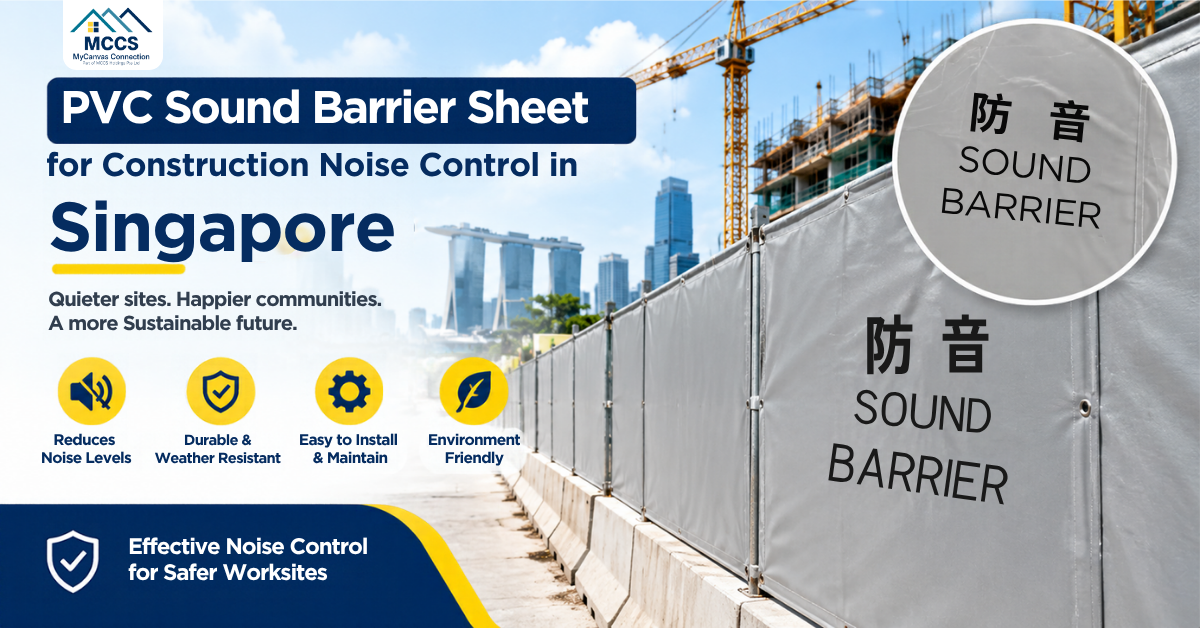
PVC sound barrier sheet hung along a construction site boundary in Singapore

PVC Sound Barrier Sheet for Construction Noise Control in Singapore
admin

Construction noise is one of the most common complaints on urban projects, and Singapore’s dense neighbourhoods make it hard to avoid. Drilling, hammering, cutting and machinery can disturb residents, offices and schools nearby. A PVC sound barrier sheet is a practical, temporary way to help manage that noise at the source. This guide explains how it works, where to use it, what to look for and how it complements protection like scaffold netting.

What Is a PVC Sound Barrier Sheet?

A PVC sound barrier sheet is a heavy, flexible PVC-based sheet hung or fixed around a noise source or along a site boundary. It helps reduce how much noise travels to the surroundings by blocking and absorbing part of the sound energy. It is lightweight compared with rigid panels, easy to install and can be removed or relocated when the work moves on.

See the product on our PVC Sound Barrier Sheet page.

How Do Sound Barriers Reduce Noise?

Sound spreads through the air and is reduced when it meets a dense, continuous surface. Three factors shape how well a barrier performs:

  • Mass and density: heavier material blocks more sound
  • Coverage and continuity: gaps, loose seams and open corners let sound leak through
  • Placement: barriers work best close to the noise source or the receiver

A barrier reduces noise, it does not eliminate it. Actual results depend on the type of noise, distance, installation quality and site layout. Ask your supplier for any performance information available for the product.

Does Scaffold Netting Reduce Noise?

No. Scaffold netting is an open mesh designed for debris and dust containment, and it allows air, and therefore sound, to pass through. If noise is the issue, you need a dedicated sound barrier. The two products solve different problems and are often used together. Read more in our construction safety netting guide.

Where Sound Barrier Sheets Are Used

Application Why it helps
Site perimeter fencing Reduces noise reaching neighbouring buildings
Around noisy equipment Contains noise from generators, compressors and cutters
Scaffold facades Helps limit noise during repair or repainting
Demolition and renovation zones Helps manage noise in occupied areas
Temporary enclosures Creates a quieter work zone for specific tasks

For perimeter solutions, you may pair the sheet with our Metal Safety Fencing.

How to Choose a Sound Barrier Sheet

  1. Identify the noise source: continuous machinery, impact noise or general site activity.
  2. Measure the area: length, height and any corners or openings.
  3. Ask about weight and thickness: heavier material typically blocks more.
  4. Check durability: UV and weather resistance for outdoor use.
  5. Look at fixing options: eyelets, reinforced edges or panels that overlap cleanly.
  6. Plan seams and gaps: overlap and seal to avoid leakage.
  7. Confirm availability of standard and custom sizes.

Installation Tips for Better Results

  • Hang the sheet as close to the noise source as practical
  • Overlap edges and seal gaps to prevent leakage
  • Avoid leaving openings at the bottom or corners
  • Secure firmly to withstand wind
  • Combine with good work practices, such as scheduling noisy tasks sensibly and maintaining equipment
  • Inspect regularly and repair tears

Noise Management Is Part of a Wider Plan

A barrier works best alongside other controls. Consider quieter equipment, scheduling, communication with neighbours and compliance with any noise limits that apply to your project. Check the applicable requirements with your main contractor or the relevant authorities; we supply materials and do not set regulatory limits.

A full site solution often combines:

Frequently Asked Questions

What is a PVC sound barrier sheet used for?

It is used to help reduce the spread of noise from construction and industrial activities by acting as a temporary barrier around the noise source or site boundary.

Does a sound barrier sheet remove noise completely?

No. It helps reduce noise. Results depend on the type of noise, distance, material and how well the barrier is installed.

Can I use scaffold netting instead of a sound barrier?

No. Netting is open mesh and does not provide meaningful noise reduction.

Is a sound barrier sheet reusable?

In many cases it can be taken down, cleaned and reinstalled at the next location, provided it is in good condition.

Can sound barrier sheets be made to size?

Share your dimensions and requirements with MyCanvas Connection to check available sizes and custom options.

Request a Quote

Tell us about your noise source, site size and conditions. Visit the PVC Sound Barrier Sheet page, request a quote, or call +65 9773 3121 / +65 6254 2940. Email: enquiry@mycanvas.com.sg.

Related reading: Construction Safety Netting Guide | Tentage Rental in Singapore

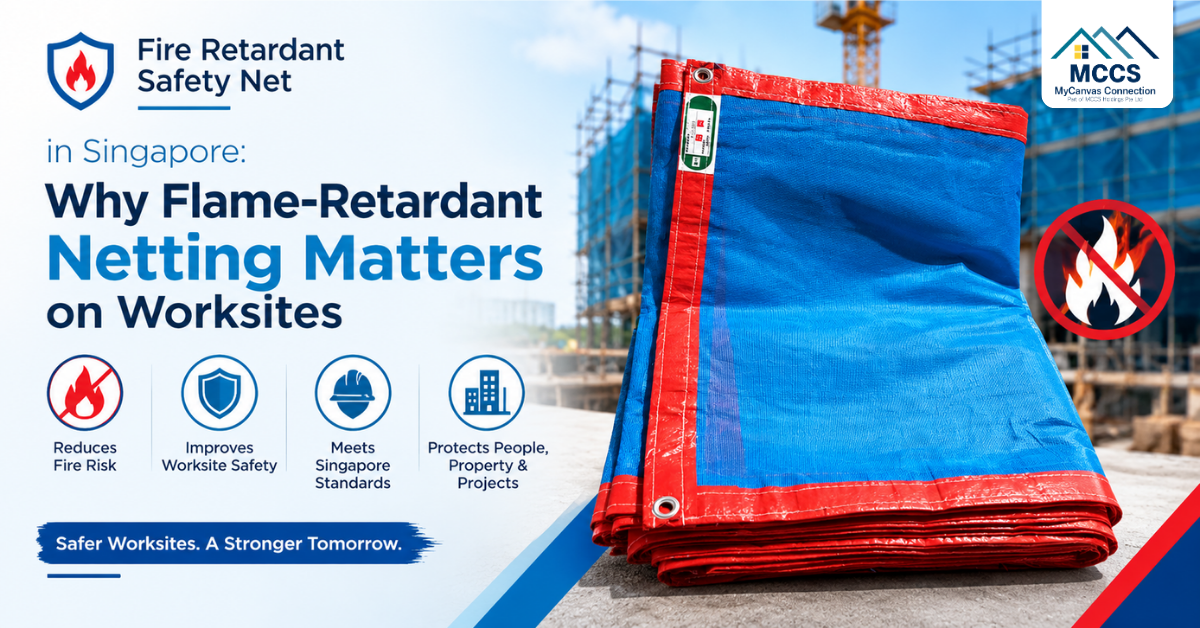
Fire retardant safety net installed around scaffolding on a construction site

Fire Retardant Safety Net in Singapore: Why Flame-Retardant Netting Matters on Worksites

admin

Most people assume the net on a scaffold is already safe in a fire. It is not always so. Standard netting is mainly designed to contain debris and dust, and it may not be flame-retardant. If your project involves welding, grinding, cutting or other hot work near the scaffold, or if the building type or contract calls for specific fire-safety measures, a fire retardant safety net is worth asking about from the start. This article explains the difference, when it matters and what to ask your supplier. It builds on our general scaffold netting guide.

What Is a Fire Retardant Safety Net?

A fire retardant safety net is a mesh netting made or treated to resist ignition and slow the spread of flame compared with untreated material. It is used in the same way as standard debris or scaffold netting, fixed to scaffolding and facades, but with an added fire-safety property.

Flame-retardant does not mean fireproof. Under sustained heat, any synthetic material can be damaged. The purpose is to reduce the risk and slow flame spread, not to make the net immune to fire.

Standard vs Flame-Retardant Netting

Feature Standard scaffold netting Fire retardant safety net
Main purpose Debris and dust containment Debris and dust containment with added fire-safety property
Fire behaviour May not be flame-retardant Designed to resist ignition and slow flame spread
Typical use General construction and repainting Hot work, specific fire-safety requirements
Documentation Basic specifications Ask for grade and test or certification information

See our standard Scaffold Netting and the Fire Retardant Safety Net for specialised requirements.

When Should You Consider Flame-Retardant Netting?

The need depends on the project, the building and applicable requirements. Common situations include:

  • Hot work near the scaffold: welding, cutting, grinding or torch work that can throw sparks
  • Contract or client specifications that call for flame-retardant materials
  • Occupied or sensitive buildings where fire-safety expectations are higher
  • Dense urban sites where a fire could affect neighbouring properties
  • Long-duration projects where netting stays up for many months

If you are unsure, check with your main contractor, safety officer or the relevant authorities about what applies to your project. We do not set regulatory requirements; we help you source materials that match them.

What to Ask Your Supplier

  1. Is this net flame-retardant, and to what standard or test?
  2. Can you provide documentation or test information for the grade?
  3. What material and weight (GSM) is it?
  4. Is it UV-stabilised for Singapore’s weather?
  5. Is it suitable for the type of work I am doing (hot work, repainting, demolition)?
  6. What sizes, colours and edge finishes are available?
  7. Can it be reused across project phases?

Fire Safety Is More Than the Net

A flame-retardant net is only one layer. Good practice on site includes:

  • Following hot work permits and procedures
  • Keeping combustible materials away from sparks
  • Having appropriate fire extinguishers within reach
  • Inspecting netting for damage or build-up of dust and debris
  • Training workers on site fire-safety measures

Netting should support, not replace, your site fire-safety plan.

Combining Netting With Other Site Protection

Flame-retardant netting often works alongside other measures. For general debris and dust, see our Dust Control Netting. For lift areas, consider our Fireman Lift Protector. For an overview of all options, browse our Construction Safety Netting range or read our construction safety netting guide.

Care and Reuse

  • Inspect regularly for tears, burn marks and loose fixings
  • Remove accumulated dust and debris, which can be a fuel source
  • Clean according to the supplier’s guidance
  • Store dry and away from heat sources
  • Retire any section showing damage

Frequently Asked Questions

Is scaffold netting fire-retardant?

Standard scaffold netting is not always fire-retardant. Flame-retardant grades may be available depending on the project and application, so state your requirement when you enquire.

What is a fire retardant safety net?

It is a mesh net made or treated to resist ignition and slow flame spread, used around scaffolding and facades in the same way as standard netting.

Is flame-retardant the same as fireproof?

No. It reduces the risk and slows flame spread, but it can still be damaged by sustained heat.

Do I need flame-retardant netting for hot work?

It is often a sensible precaution when sparks are likely, but requirements vary by project. Confirm with your main contractor or safety officer.

Can I get documentation for the grade?

Ask the supplier for grade and test information when you request a quote.

Get a Fire Retardant Safety Net Quote

Tell us your project type, dimensions and fire-safety requirements. Visit the Fire Retardant Safety Net page, request a quote, or call +65 9773 3121 / +65 6254 2940. Email: enquiry@mycanvas.com.sg.

Related reading: Scaffold Netting Buyer’s Guide | Construction Safety Netting Guide

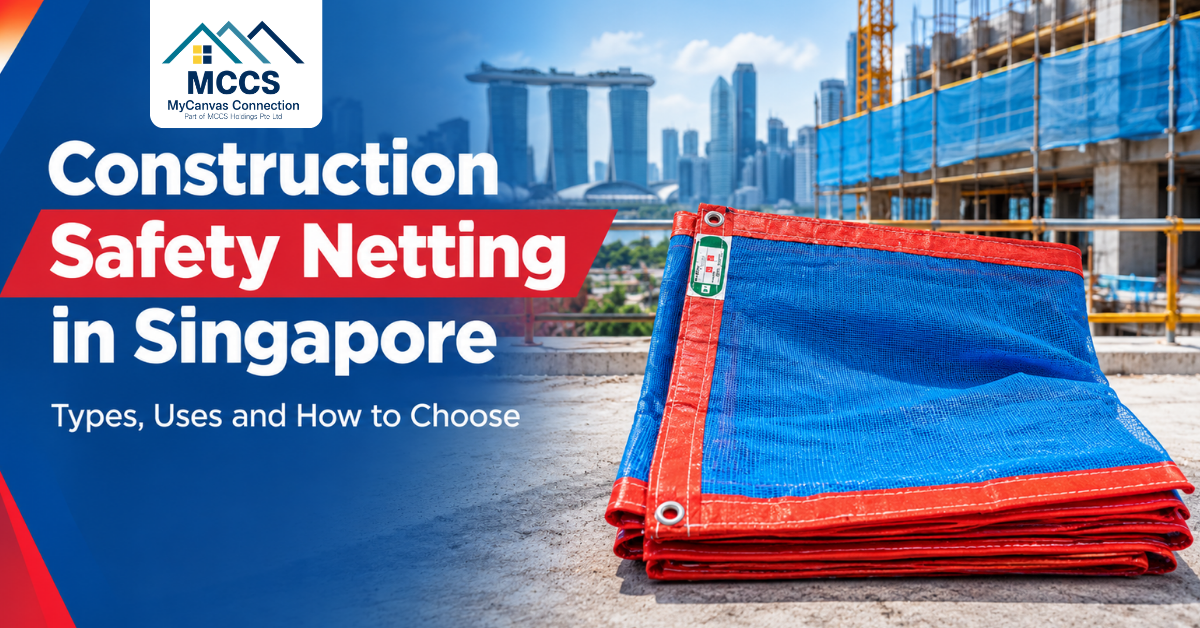
Construction safety mesh netting covering a scaffold on a Singapore building site

Construction Safety Netting in Singapore: Types, Uses and How to Choose

admin

“Safety net” is a broad term on construction sites. One supervisor might mean a debris net on the scaffold, another a catch net below a work platform, another a dust screen along a boundary. Choosing the wrong one wastes budget and leaves gaps in protection. This guide breaks down construction safety netting in Singapore, the main types, what each one does, and how to match the product to your site. It sits alongside our dedicated guide to scaffold netting.

What Is Construction Safety Netting?

Construction safety netting is the family of mesh products used on worksites to contain falling objects, control dust, screen work areas and protect workers and the public. The mesh is typically made from high-density polyethylene (HDPE) or similar synthetic materials, and is fixed to scaffolding, building facades or perimeter frames.

No single net does everything. The right choice depends on the hazard you are managing.

The Main Types of Construction Safety Netting

Type Main purpose Typical placement
Scaffold / debris netting Contain small debris, tools and dust Outer face of scaffolding and facades
Horizontal catch / fan netting Catch objects beneath elevated work Below work platforms and edges
Dust control netting Reduce airborne dust spread Facades, demolition and repainting zones
Safety mesh netting General site screening and protection Perimeters, openings, temporary structures
Flame-retardant netting Meet specific fire-safety needs Projects with fire-safety requirements

Browse the full range in our Construction Safety Netting category.

Matching the Net to the Hazard

Falling debris and tools

Start with scaffold netting on the outer scaffold face. Add horizontal catch netting where work happens above walkways or public areas.

Fine dust from grinding, sanding or repainting

Choose finer mesh and higher weight. Our Dust Control Netting is designed for this kind of application.

Fire-safety requirements

Some sites or building types call for flame-retardant materials. Ask for the right grade at enquiry stage. See our Fire Retardant Safety Net and the related guide, Fire Retardant Safety Net in Singapore.

Noise from site activity

Netting does not significantly block noise. For noise management, consider a barrier solution such as our PVC Sound Barrier Sheet.

What to Look for in Quality Netting

  • HDPE construction with UV stabilisation for outdoor durability
  • Reinforced edges or eyelets for secure fixing
  • Consistent mesh without loose or uneven stitching
  • Suitable weight (GSM) for your wind and dust conditions
  • Clear specifications from the supplier, including grade and available sizes

Installation and Care Tips

  1. Confirm the arrangement with your scaffolder or safety officer before ordering.
  2. Fix at regular intervals to avoid sagging and tearing.
  3. Overlap panels and secure the seams.
  4. Inspect regularly, especially after heavy rain or strong wind.
  5. Replace damaged sections promptly.
  6. Clean and store properly if you plan to reuse the netting.

Netting supports, but does not replace, proper scaffold design, inspection and your site safety plan.

Applications Across Singapore Projects

  • HDB upgrading and estate renewal
  • Condominium and commercial developments
  • MRT and infrastructure works
  • Facade repair and repainting
  • Demolition and renovation
  • Temporary structures and site perimeters

For perimeter boundaries, you may also look at our Metal Safety Fencing.

How to Choose: A Quick Decision Guide

  1. Identify the hazard: debris, dust, fire, wind, or a mix.
  2. Measure the area: height, length and any cut-outs.
  3. Check conditions: wind exposure, building height, proximity to the public.
  4. Decide the grade: standard or flame-retardant.
  5. Plan reuse: single project or multiple phases.
  6. Ask a supplier to confirm specs against your project details.

Frequently Asked Questions

What is construction safety netting used for?

It is used to contain falling debris, manage dust, screen work areas and help protect workers and the public around construction sites.

Is construction safety netting the same as scaffold netting?

Scaffold netting is one type of construction safety netting. The wider category also includes catch nets, dust control netting, safety mesh and specialised flame-retardant grades.

Can safety netting stop noise?

No. Netting is not designed for sound control. A dedicated barrier sheet is better suited to noise management.

How do I know which type I need?

Start with the hazard you are managing, then confirm mesh, weight and grade with your supplier based on the site conditions.

Do you supply custom sizes?

Contact MyCanvas Connection with your dimensions and requirements to check available roll and custom-cut options.

Request a Quote

Share your project details and we will help you identify suitable netting. Browse the Construction Safety Netting range, request a quote, or call +65 9773 3121 / +65 6254 2940. Email: enquiry@mycanvas.com.sg.

Related reading: Scaffold Netting Buyer’s Guide | Construction Noise Control with PVC Sound Barrier Sheets

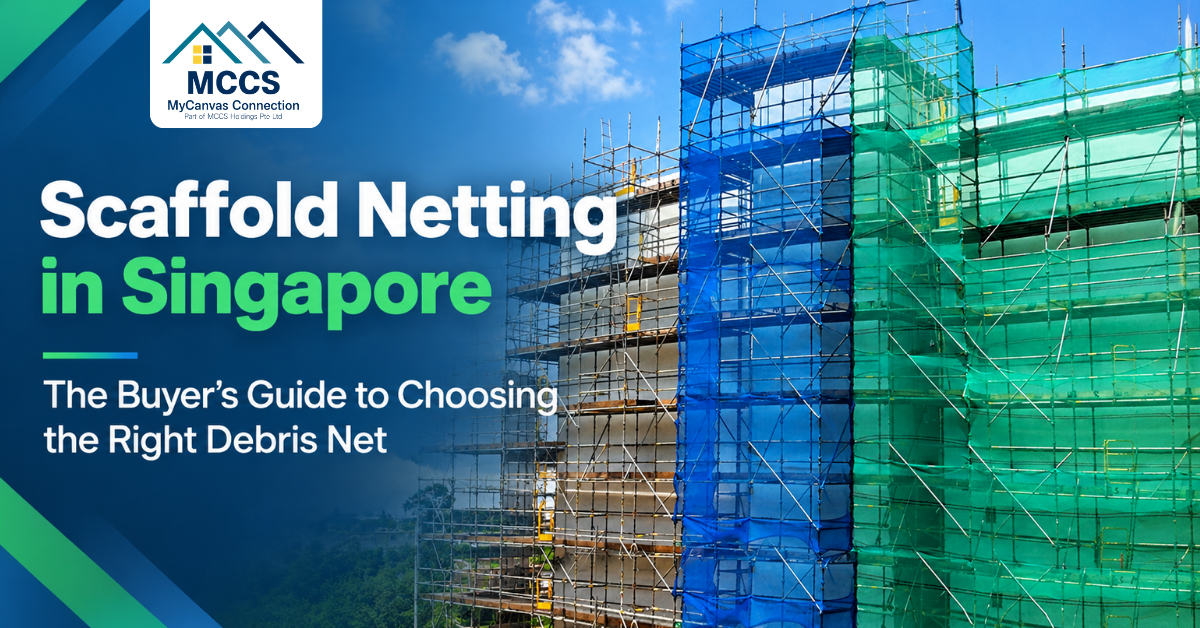
Green scaffold netting installed on a building facade in Singapore

Scaffold Netting in Singapore: The Buyer’s Guide to Choosing the Right Debris Net

admin

Every active building site has the same problem: things fall. Offcuts, fasteners, paint chips and dust all drift outward from scaffolding and elevated work areas. Scaffold netting is the simple, practical layer that helps contain them. If you are sourcing scaffold netting in Singapore for an HDB upgrading job, a condominium repaint or a commercial A&A project, this guide explains what to look for so you order the right net the first time.

What Is Scaffold Netting?

Scaffold netting, also called debris netting or building netting, is a lightweight, fine-mesh fabric fixed to the outside of scaffolding or building facades. It helps contain falling debris, small tools, dust and offcuts before they reach the ground, and it screens the work area from the surrounding neighbourhood.

Most scaffold nets are made from woven or knitted high-density polyethylene (HDPE). The material is light, breathable, weather-resistant and can be reused across projects when properly cared for.

Why Scaffold Netting Matters on Singapore Worksites

Singapore sites are tightly packed. Many projects run beside occupied homes, schools, roads and walkways, so the zone around a worksite is rarely empty. Netting contributes in four ways:

  • Debris containment: keeps loose material close to the structure instead of drifting onto people and property below.

  • Dust management: reduces how much fine dust travels into neighbouring areas. For heavy dust applications, see our Dust Control Netting.

  • Screening: gives a tidier, more organised look to work in progress.

  • Weather performance: permeable mesh lets wind pass through, which helps reduce wind load compared with solid sheeting.

Netting is one layer of site protection, not a replacement for proper scaffold design, inspection and site safety procedures. Always follow your main contractor’s safety plan and applicable requirements.

Material Matters: HDPE and UV Stabilisation

Singapore combines strong sun, heavy rain and occasional haze. A cheap net that has not been UV-stabilised can become brittle and tear early. Look for:

  • HDPE construction for tear strength and light weight

  • UV stabilisation so the fabric holds up under long outdoor exposure

  • Reinforced or eyeleted edges so cable ties or bungee cords do not rip through the border

You can see the range on our Scaffold Netting product page.

Vertical vs Horizontal Scaffold Netting

Type Where it goes Best for
Vertical (facade) netting Fixed down the outer face of the scaffold Perimeter coverage, debris and dust containment, screening
Horizontal (fan / catch) netting Installed as a platform or fan below elevated work areas Extra protection beneath active work zones

Many projects use both: vertical netting for the perimeter and horizontal netting where extra catch protection is needed. Your scaffolder or safety officer should confirm the arrangement.

How to Choose the Right GSM and Mesh

GSM (grams per square metre) indicates fabric weight. In general, a heavier, finer net contains finer material but catches more wind.

Site condition Suggested direction
General debris, wind-exposed high-rise Standard mesh, moderate GSM for airflow
Sanding, grinding, repainting, fine dust Finer mesh, higher GSM
Fire-safety requirement on the project Flame-retardant grade (see our Fire Retardant Safety Net)

Specifications vary by supplier and stock. Share your project details and let the supplier confirm the exact grade.

Five Common Mistakes When Buying Scaffold Netting

  1. Choosing only on price. A net that tears in a few weeks costs more in the end.

  2. Ignoring wind. Very dense netting on a tall, exposed scaffold can increase wind load.

  3. Skipping the fire question. If your project needs a flame-retardant grade, ask before ordering.

  4. Weak fixing. Poor edges and too few fixing points cause tears and sagging.

  5. Wrong quantity. Measure the full facade and allow for overlaps and cut-outs.

Pre-Order Checklist

  • Facade or scaffold dimensions (height x length)

  • Type of work (structural, repainting, demolition, façade repair)

  • Dust level: low, medium or high

  • Wind exposure and building height

  • Fire-safety requirements, if any

  • Preferred colour and roll or custom-cut format

  • Fixing method (cable ties, bungee, tape)

  • Reuse plan across project phases

Where Scaffold Netting Is Commonly Used

  • Building construction and A&A works

  • HDB upgrading projects

  • Condominium and commercial developments

  • MRT and infrastructure sites

  • Façade repair and repainting

  • Demolition and renovation projects

For a wider selection of protective materials, browse our Construction Safety Netting range, or the full Safety Net Singapore category.

Frequently Asked Questions

What is scaffold netting used for?

Scaffold netting provides protective coverage around scaffolding and construction areas. It helps contain falling debris, loose materials and dust, and supports safer conditions for workers and people around the site.

What GSM scaffold netting do I need?

It depends on the work. Lighter netting suits general coverage and wind-exposed sites, while heavier, finer netting suits fine dust and denser debris. Confirm with your supplier based on your project.

Is scaffold netting fire-retardant?

Not always. Standard grades may not be flame-retardant, but flame-retardant grades may be available. State your requirement at the enquiry stage.

Can scaffold netting be reused?

In many cases yes. If the net is in good condition, it can be cleaned and redeployed across project phases.

What is the difference between debris netting and safety netting?

Debris or scaffold netting is mainly for containing smaller debris and dust around scaffolding and facades. Safety netting can serve other protective purposes depending on material and installation.

Get a Scaffold Netting Quote

Tell us your project size, site conditions and preferred specification, and our team will recommend suitable options. Visit the Scaffold Netting page, request a quote, or call +65 9773 3121 / +65 6254 2940. Email: enquiry@mycanvas.com.sg.

Related reading: Construction Safety Netting Guide | Fire Retardant Safety Net